
Another pre-dawn start. I was eager to reach Cahokia Mounds today, a UNESCO World Heritage site: the ruins of a huge, sprawling thousand-year-old city just outside St. Louis. But I decided that I would first take a short detour to a place claiming to be “The World’s Largest Truck Stop” just west of Davenport, Iowa on Interstate 80 (thank you Atlas Obscura).

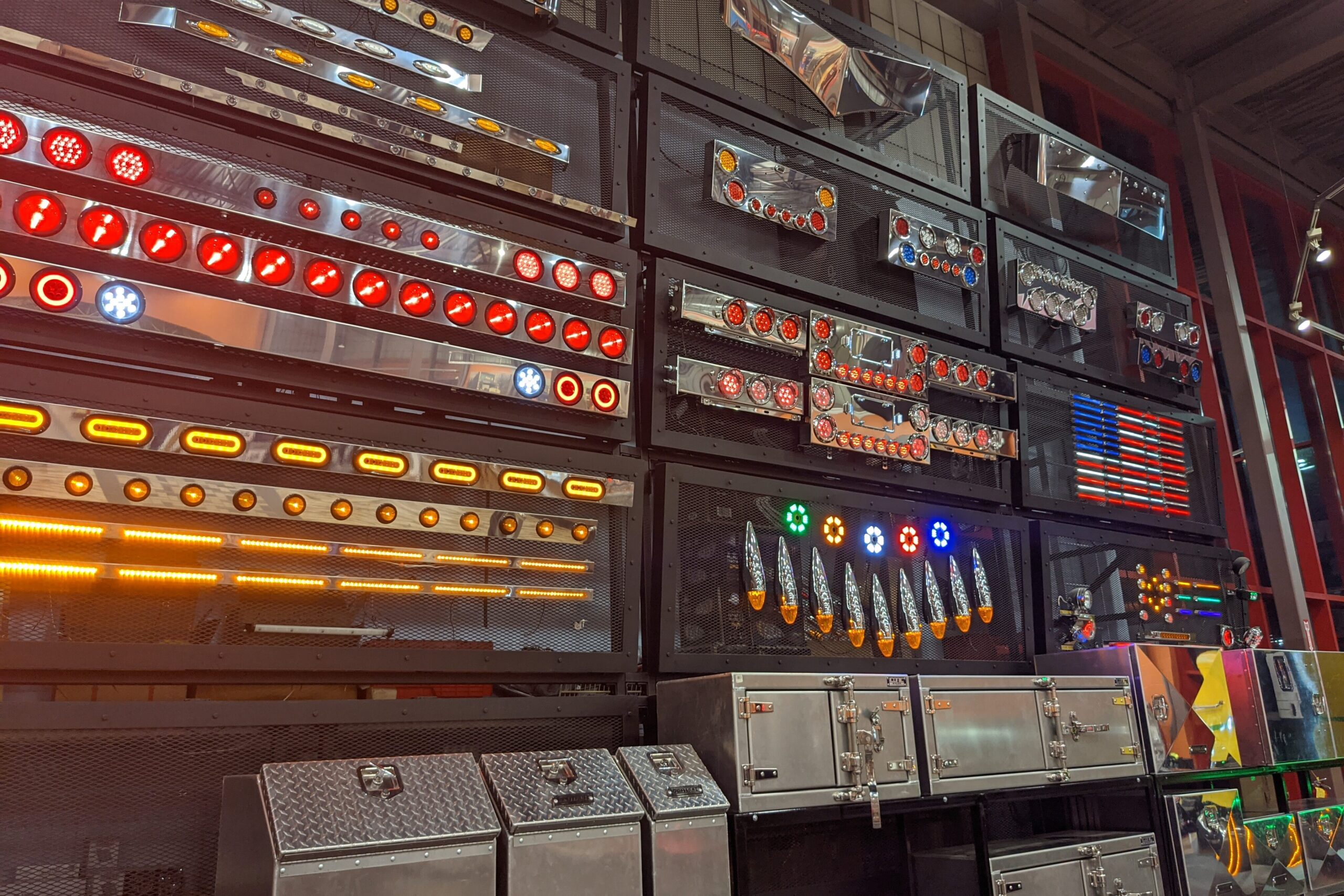
The place is designed to attract both long-haul truck drivers and curious bourgeois tourists like me. I stumbled out of my car into the predawn darkness and headed for the massive and brightly-lit retail palace, eager for coffee. It was too early to visit the trucking museum, but there was plenty to see.
The tourist-facing part is part oversize shopping-mall food court and part gift shop. This connected to a truck showroom, a stunningly comprehensive truck accessory superstore, and a variety of businesses offering services for long-haul truckers. My plan to reach Cahokia early meant I didn’t have time to explore the offerings for truckers, but I noticed showers, a laundromat, a movie theater, a library, a gym, a pet washing station (“the dogomat”) a barber, a dentist, and a chiropractor. I wandered around a bit, fantasizing about buying my little blue Subaru some garish external lights or a set of shiny, powerful chrome air horns. But I came to my senses. Filling up the stainless-steel insulated mug that was starting to feel like a dear friend and loyal companion, I grabbed a bagel from the food court, and jumped back behind the wheel in time to watch the sun rise somewhere between Davenport and Peoria.


Illinois dragged on with little of interest scrolling by my windows. For most of my life, like most coastal people, I had only the foggiest sense of the Midwestern states. I lumped Illinois, Iowa, and Indiana together into “Those Flat ‘I’ states” 1. This drive had me wondering whether all those places were really just Illinois. It’s a ridiculously long state, with a head in the cold waters of Lake Michigan and feet in Kentucky bluegrass. Rolling South down I55, I listened to podcasts about Cahokia and dreamed about what the ancient native American urban complex might have been like. This kept me occupied, but not too distracted to notice a highway sign about 40 miles north of St. Louis that read “Mother Jones Monument.”

Schedule be damned, I had to see this. Mary Harris “Mother” Jones was an iconic labor leader. Born in Cork, Ireland she emigrated to the America during the great famine and became one of the most well-known labor organizers of the early 20th century. She was known as a brilliant orator and a fearless fighter against child labor and for the rights of mill workers and miners. I pulled off the highway and followed the signs to where a monument and a gravestone mark her final resting place. The monument commemorates not just Mother Jones, but the “Martyrs of the Progressive Miners of America,” twenty-one union miners who were killed in strikes, massacres, and other labor battles.
In 1898 coal miners in nearby Virden went on strike over wages. Thirteen died in clashes between strikers, scabs, and company stooges in what came to be called The Battle of Virden. Four miners were refused burial in the Mount Olive town cemetery though they had lived in the town. Its private owner feared their graves would become a shrine to unionized workers. The United Mineworkers bought a piece of land and created the Union Miners Cemetery.

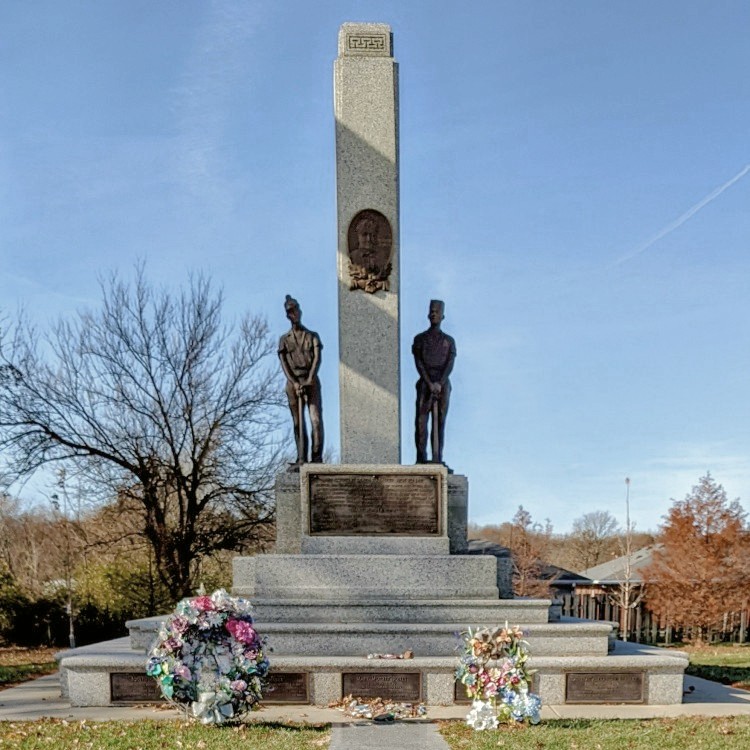


Approaching the monument I was moved to see that visitors had placed stones on her grave (a Jewish tradition), along with a variety of union buttons, pins and other memorabilia. To my surprise, directly across from Mother Jones’ grave was a bench and headstone commemorating Anne Feeney, a folk and labor music songwriter and performer who had died just a few months ago from complications of COVID-19. I was only vaguely familiar with her work, but before I drove off I went online, found some of her music and listened as I drove on to Cahokia. Her tune “Have You Been to Jail for Justice,” mentioned Rosa Parks and Martin Luther King. It seemed a fitting musical prelude to the Civil rights landmarks I planned to visit in the deep South.
The archaeological evidence at Cahokia challenges what I was taught in school about the native inhabitants of North America. I’d been told that they were all hunter-gatherers who lived a nomadic, tribal life, in contrast to the sophisticated urban life of the European colonizers. In fact, even the earliest white explorers and settlers in the Mississippi valley knew that there were imposing ceremonial mounds and surrounded residential areas here and elsewhere. They just didn’t believe that these could have been created by the “primitive” peoples they encountered. They invented stories about a mythical ancient “mound builder” civilization that predated the people they were busy killing, infecting with disease, and pushing from their homelands . It wasn’t until the 20th century that archaeologists began to acknowledge that there had been a large, complex urban civilization near present-day St. Louis. This city of perhaps 20,000 (larger than London at the time) flourished between around 900 and 1100 AD while Europe was passing through its medieval period.
In fact, there are hundreds of native American mound sites scattered across the Mississippi Valley and Southern Appalachia. “Mound” may not be the best description of some of the large structures. These are huge, carefully engineered and built structures raised in a region with little stone or timber. Larger than the cathedrals of Europe, these pyramids were erected without the use of of wheels or draft animals. This is the largest of these sites, a city by anyone’s reckoning. We call it “Cahokia” though nobody knows what the people who lived here called it, or called themselves. The site was named by French settlers after a tribe that lived in the area in the 1600s.

Cahokia today is a complex of some 120 earthen mounds and wide plazas across the river from downtown St. Louis. Many more mounds, plazas, and other structures in the area have been obliterated by farms and roads, but this vestige is preserved and managed as an Indiana state park. The largest and most impressive one is called “Monk’s Mound,” not because of any spiritual significance to its builders, but because of French Trappist Monks who lived (and tried to build a cathedral) there in the early 1800s. Monks Mound rises in four terraces from a base bigger than any of the pyramids of Egypt. It’s built entirely of various local soils, carried to the site on people’s backs: over 14 million basket loads. Nobody knows why it was built or what its function was.
I climbed the stairs to the summit of Monks Mound. From the top, I could see some locals huffing and puffing up and down the 156 steps. The stairs were built by the state park in the same location as the structure’s original steps. It’s a popular training spot for athletes from St. Louis.
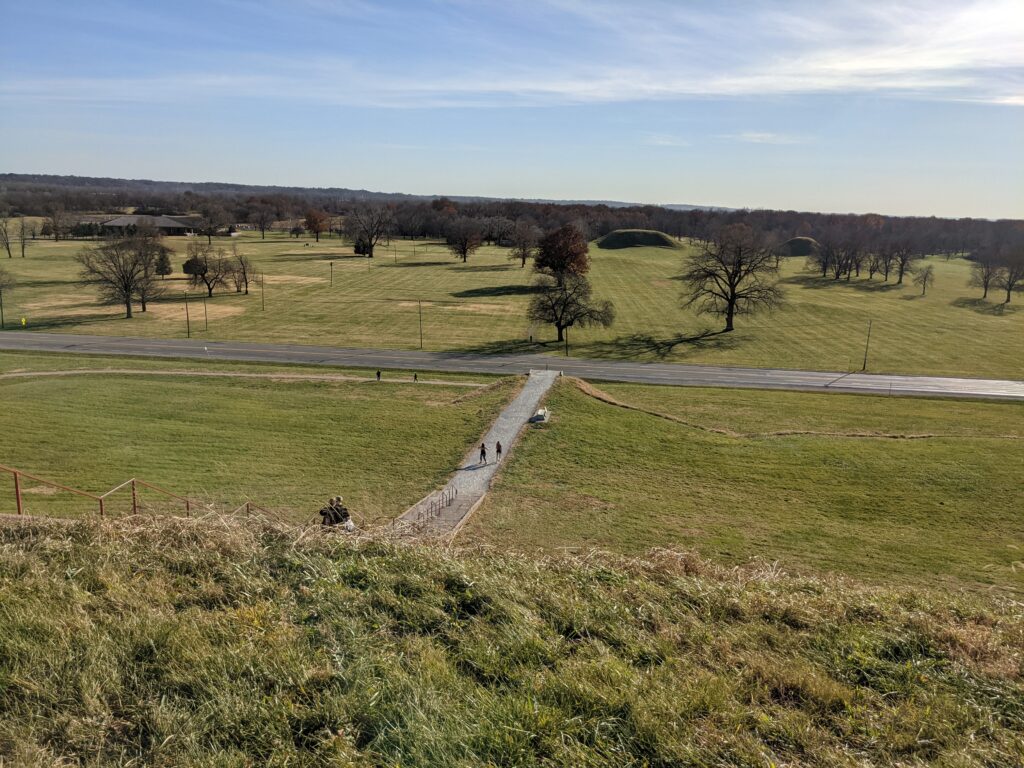
The summit is flat, and the archaeological evidence tell us that when Cahokia was a city it was topped by buildings, including one massive one, probably the home of the charismatic leader (King? Queen? Priest?) of the city. I looked out across the extensive plazas that faced the mound. These had been leveled, cleared, and prepared for ceremonies and massive sports events. Cahokians played a game called “Tchung-kee” or “chunkey.” Chunkey players roll a stone puck along the ground, then chase it. The goal is to land a spear as close as possible to the spot where the puck stops . Playing and betting on chunkey seems to have been a tremendously important part of their day to day life. It seems to have been closely tied to religious and political life, more important to Cahokian’s lives than football is to the even the most fanatical modern Americans. Chunkey is also an important cultural thread tying these ancient civilizations to the present day. The game remained popular among Cherokee, Chickasaw and Choctaw long after white colonists arrived. It’s still played, and is experiencing something of a revival.

At the summit I saw signs explaining that there is a project is underway to create an “augmented reality” application. Alas, it’s not available yet, but soon we’ll be able to peer at a phone or tablet to see mounds, buildings, plazas and clusters of homes and other structures superimposed over a phone cam’s view of the landscape, just as we suppose they would have looked to the ruling elite at the height of the civilization. I hope I’ll get a chance to return for this.
At the other end of the plaza were several smaller mounds. In the distance to the West I could see the skyline of St. Louis, dominated by the Gateway Arch. In front of that ran the Mississippi, just below where it meets the Missouri. Cahokians were a trading culture, importing and exporting up and down the entire Mississippi and Missouri basins and beyond. Copper from the Upper Great Lakes, glittery Galena, shells from the Gulf of Mexico, and mica from the Appalachian mountains have been found at Cahokia. Cahokian-style pottery is found across the middle of North America. Tea made from Yaupon, a highly-caffeinated herb that only grows far south of Missouri, appears to have been a big part of the culture.
We don’t know much about the culture or daily life of the Cahokians. We do know that the city was led and possibly founded by a charismatic leader, and that human sacrifice was as much a part of the religion and culture of the city as sports fandom. In the 1960s archaeologists opened one of the smaller mounds and found hundreds of skeletons. Two of these appear to have been a man and woman of great prestige, buried with ceremony and surrounded by thousands of valuable trade goods (rolls of copper, arrowheads, chunkey stones, and shell beads from the Gulf of Mexico). Others buried there seem to have been less honored. The bones of fifty-four young women were found, along with dozens of other bodies that appear to have been buried alive or clubbed at the edge of their grave site.

Near Monks mound there’s a structure named “Woodhenge” (after England’s Stonehenge). Here were once circles of telephone-pole-like posts arranged to track sunrise at different times of the year,. Standing in the center of these circles at the fall or spring equinox you can see the sun rise directly over Monks Mound. The winter solstice aligns with another mound. In 1985 the henge was partially reconstructed. Though we know nothing of how this structure was once used there are now solstice ceremonies here, attracting native peoples and others from nearby and far away.

Cahokia was abandoned by the end of the 14th century, long before Columbus arrived. Why this happened is, like almost everything else about its history, a mystery.
I had arrived at Cahokia with plenty of time to visit the interpretive center, walk around the place, climb Monks Mound, and view some of the smaller ones. By mid afternoon I had seen everything I wanted to see there. My room (at a cheap place that I picked because I liked the name: “Indian Mound Motel”) wasn’t ready, and seemed to be a less than inviting place to spend the afternoon, so I started to see if there was anything in nearby St. Louis worth visiting.
The Gateway Arch was the big tourist draw, but I hadn’t planned to visit. I had a few reasons for this.
First, the whole idea of building a moment to Thomas Jefferson’s vision of Western expansion rankled. I worried it would be a celebration the idea of America’s “Manifest Destiny,” the philosophy that lead to the removal of native populations, the invasion of Mexico, and much other nasty stuff.
Second, the arch was designed by architect Eero Saarinen. He was a quintessentially modernist architect and his name brought to mind some of the inhuman concrete, glass and steel boxes that I remember from my New York childhood 2.
Third, the site of the Gateway Arch was the result of the 1960s misguided “Urban Renewal” movement. The city’s “Mill Creek Area,” a black neighborhood, was demolished to build the riverside park where the arch is planted. Families were uprooted, beautiful cast-iron-front buildings that housed black-owned businesses were demolished, and a new interstate highway was built, cutting the city’s connection to the river 3.

Mayor and Urban Renewal advocate looking out at the soon-to-be demolished Mill Creek Valley neighborhood
©Missouri Historical Society
But it was getting late in the afternoon, the sun would soon set, and there wasn’t much to see in scruffy industrial East St. Louis where I was staying. Plus the arch was part of the National Park system, and I’ve never been disappointed with any visit to a National Park. So I braved some terrifying urban traffic (a shock after my slow ramble down scenic ‘blue’ highways), parked in one of the tall, creepy brutalist garages near the site, and strolled down to the park.
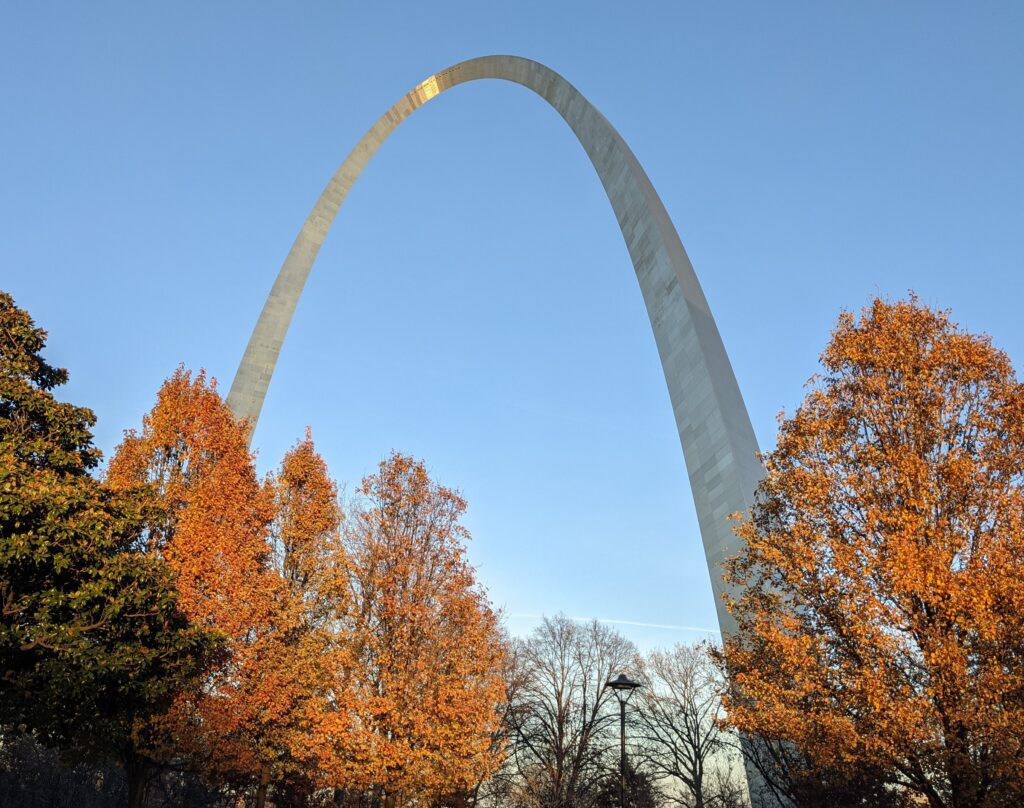
To my joy and surprise the arch itself was beautiful, especially with the late afternoon winter sun painting its silver exterior with color. Then I learned that visitors can visit the top and look out at the city. I was invited to visit the museum while I waited for the next ride to the top. The museum is built underground at the base of the arch. It’s an excellent museum: well-researched, recently rebuilt, free to the public and well designed.
I was surprised to find a the thoughtful, even-handed treatment of Western Expansion. I had expected a dramatic Disneyesque fanfare of American greatness, telling an heroic tale of doughty settlers conquering an empty wilderness. There was certainly some of that (even a cynic like me finds plenty to be proud of in the American story), but the exhibit pulled no punches when it came to telling stories about the genocidal policy of Indian removal, the role of slavery in our conquest of Mexico, and other shameful aspects of our history.
These are stories that for most of my life had been swept under that carpet and ignored. I’m glad that someone in the park service believes that telling these stories alongside the usual tales of glory and advancement is the only way to nurture truly patriotic citizens.

The visit to the top of the arch was another unexpected joy. Individual pods ride to the summit on a system that is part elevator, part roller coaster, and part train. Covid protocols meant that I got a pod to myself. A recent renovation enhanced the lovely mid-century modern look of the pods. They reminded me of the “EVA Pods” from the movie 2001, and I suspect the rebuild was an homage to some of Saarinen’s designs. While we waited in our social-distance lines to board we watched a multimedia presentation that made the most of the 1960s aesthetic to tell the history of the arch and of St. Louis.
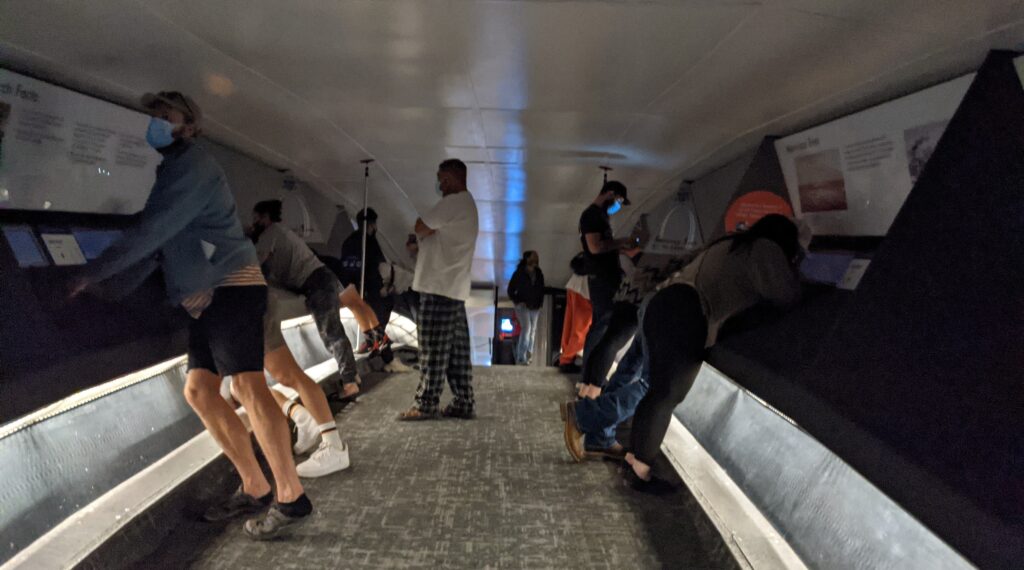
When we reached the top I was again reminded of 2001, this time the scene where astronaut Frank Poole is shown jogging around the inside rim of the spinning centrifuge-spacecraft. But this floor, at the peak of the arch, curves in the opposite direction, gently sloping up to the highest window. Looking out to the West, the Old Courthouse and the surrounding parks and buildings looked toy-like. To the east was the Mississippi, and beyond it the industrial wasteland of Illinois, the Cahokia mounds hidden in the darkness.

There was one more thing I did not want to miss before I left St. Louis: frozen custard. I’m a huge fan of soft-serve ice cream. In Vermont we call this “creemee,” and usually serve it in a cone, but in St. Louis they serve it in a cup, and they like it thick. Thick enough to scoop. So thick that you can flip the cup upside down without fear of spillage. So thick that they’ve given the unappetizing name “concrete” to a cup of the stuff with mix-ins. Jane and Michael Stern’s “Roadfood” claims that Ted Drewes Frozen Custard offers the platonic ideal of a concrete, so off I went.
I was surprised that it was hard to find a parking spot in the almost-suburban residential-commercial neighborhood, and I soon discovered why. On this cool, dark December night a huge crowd of people were lined up outside the tiny, white, neon-lit Ted Drewes custard shop. Others milled about eating their sundaes, cones, and concretes and browsing the Christmas trees that Drewes sells as a winter sideline.

Their menu is bewildering long, and I was grateful that the long wait on line gave me a chance to read it and make a choice. I was tempted by the Cinna-Crunch (cinnamon and pecans), the Caramel Apple Sundae (Apple pie, custard, caramel and almonds), the Southern Delight (praline pecans and butterscotch),the Twisted Caramel (salted caramel and pretzel bits), the Dottie (mint, chocolate and macadamia nuts), the All Shook Up (An homage to Elvis featuring Reese’s Peanut Butter Cups and bananas ), and the Lemon Crumb (lemon cream and graham crackers) but by the time I reached the counter I had settled on the Cardinal Sin, with tart cherries and hot fudge. And yes, I did turn it upside down to confirm its fabled consistency.
I headed back to East St. Louis, battling aggressively bad drivers that rival those of Boston. I checked in to Indian Mound Motel (which proved, despite its unattractive exterior, to be clean, safe and comfortable enough for me). I drifted off to sleep, anticipating another early start tomorrow so I could enjoy some daylight at a place called “The Land Between The Lakes.” a National Recreation area just South of where Illinois, Kentucky, and Tennessee meet.
- sometimes Idaho and Ohio made the list, which shows you how poor my knowledge of geography was
- I’ve since learned that my judgment of Saarinen wasn’t fair : he also created some pretty cool buildings like the TWA terminal at JFK airport, not to mention his iconic “tulip” chair
- That particular mistake at least was mitigated during an early-200s revamp that built a park over part of the highway, connecting the city to the Arch site and the riverfront
The arch was amazing to visit but my ice cream loving heart is super-jealous of your visit to Ted Drewes.