
Harpers Ferry 1 is situated in a tiny chunk of West Virginia called the Eastern Panhandle. The town marks the easternmost point of the state, wedged into the confluence of the Potomac and Shenandoah Rivers mark the borders of Virginia and Maryland. I said farewell to Virginia and pulled into the small cluster of low brick national park buildings just off the divided four-lane highway. The late 20th-century style visitor’s center didn’t look like much, offering a few exhibits and an ample parking lot, but signs told me there was a shuttle bus to the town’s historic district, and a map showed that there was a trail.
It was a short, steep hike into “Lower Town,” a pretty place of narrow streets, tourist-oriented shops, and restored National Park buildings. It became clear why the new visitor’s center was built on the hill above; there wasn’t much room for cars here. Harpers Ferry lower town is an unusual mix of publicly owned National Park buildings and private businesses like inns, restaurants, and souvenir shops. It was really quite charming; The stores were more interesting and less schlocky than I expected.
I stepped into a place called True Treats Historic Candy. The owner is a food historian and author who takes candy history seriously, and the store is probably unique among candy shops with the shelves organized by century. It is probably the only place in the world one could buy gift boxes of treats from the Revolutionary or Civil War era. I noticed a reminder that I was in the bible belt, a “Biblical Sampler” featuring sweets made with ingredients mentioned in scripture (honey, grapes almonds, and assorted “Botanicals of the Bible”).

Fortified with some historically-authenticated jellybeans, I stood at what’s known as The Point, Virginia to my right and Maryland to my left. In front of me was the Potomac, winding its way towards Washington, DC. (about 70 miles downstream from here). Two lovely old iron railroad bridges cross to the Virginia side, one now a pedestrian bridge, the other still carrying trains. Today was bright and sunny, and the sun sparkling on the water was beautiful, but I wasn’t here for the view. I came to this place to understand a little more about John Brown’s raid here in 1859.
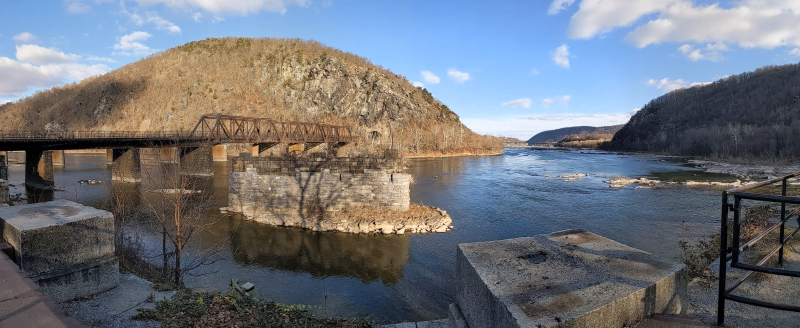
Joanna and I have visited Brown’s grave in North Elba, New York, just across Lake Champlain from where we live. I’m fascinated by this man’s life and his death; His story challenges some of my most firmly-held beliefs. John Brown’s single-minded goal was the complete destruction of America’s slave system. Smashing this great evil was his only moral compass. I lean towards pacifism, but Brown would have had nothing but scorn for Ghandi’s or King’s ideas about nonviolent action. I see him simultaneously as an inspired, prescient moral leader and a bloodthirsty terrorist. And beyond that, I see his lifelong struggle as both a total ignominious failure and a brilliant success.
In the 1850s most Americans didn’t expect the bloodbath of the coming Civil War, but it was getting harder to avoid noticing what it meant to have a nation that waas half free and half dependent on enslaved workers. The Fugitive Slave Act made every American legally responsible for the return of human “property” to the enslavers. People in New York, Massachusetts, and other free states were horrified to see men and women marched in chains through their streets and sent South under the supervision of the U.S. military. Then, in 1854, the Kansas-Nebraska act passed. This overturned the ban on slavery in newly-admitted states 2, declaring that the frontier territory of Kansas could vote on whether to be a slave or free state.
It was in Kansas that John Brown and his sons took up arms. Most of the handful of settlers there were opposed to slavery, but slave-holding “Bushwhackers” rushed across the Missouri border to vote there. To counter this, Northeastern abolitionists headed to Kansas. At first the bushwhackers merely stuffed ballot boxes, intimidated free-state voters, and engaged in other kinds of election fraud, but things soon took a much darker turn. In the spring of 1856 a pro-slavery posse ransacked the free-soil town of Lawrence 3, destroying abolitionist printing presses and burning a hotel.

A few days later Brown and his sons retaliated, killing five Bushwhackers in what became known as the Pottawatomie Massacre. Pro-slavery forces then invaded Brown’s base in Osawatomie, Kansas. One reciprocal massacre followed another, and people started calling the territory Bleeding Kansas. These battles flared on and off until 1861 when Southern states seceded. Without Southern votes, Congress was able to quickly admit Kansas to the USA as a free state.
But before that, in the early 1850s, John Brown was already raising funds and and gathering support for his own war. It would begin with a small band of insurgents capturing the U.S. Armory at Harpers Ferry. They would seize the armory’s thousands of muskets and rifles and arm enslaved workers in the surrounding Virginia countryside. Victory here would set off a chain reaction of armed rebellions. The guerilla war would spread across the mountains of Virginia into Tennessee, the Carolinas, Alabama and the rest of the South, ending slavery forever. Brown recruited twenty-one fighters, a mix of freed and fugitive blacks and white sympathizers, and in October of 1859 they marched on Harpers Ferry.
As you probably already know, the Harpers Ferry raid failed. US Marines captured Brown and his men 4 and before the year was over Brown was hanged.
Before the raid Frederick Douglass and other abolitionists had refused to back Brown’s plan, skeptical that it could succeed. Now it seemed obvious that they had been right. William Lloyd Garrison’s abolitionist paper “The Liberator” published a story called “The Tragedy at Harpers Ferry.” It called Brown a hero but called his action “a well-intentioned but sadly misguided effort.”
The story seemed to be over. His assault had come to nothing, and Brown was as good as dead and buried. Yet something about the man and his quixotic attempt to spark a war to end slavery captured the imagination of the nation, sparking hope in the North and fear in the South.
Henry David Thoreau was one of the first to praise Brown. Between Brown’s arrest and his hanging Thoreau gave a rousing speech in Concord, later published as “A Plea for Captain John Brown.” He railed against Northern Abolitionists who disavowed the raid, saying that Brown “.. was a superior man… He could not have been tried by a jury of his peers, because his peers did not exist.” He compared Brown to Jesus and the Federal government to Pontius Pilate: “You who pretend to care for Christ crucified, consider what you are about to do to him who offered himself to be the savior of four millions of men.”
Meanwhile, in the South, the Richmond Enquirer called the attack a “Treasonable invasion of a Southern State” by “the Black Republican Osawatomites of the North” and warned that “The Harpers Ferry invasion has advanced the cause of Disunion, more than any other event that has happened since the formation of the Government…it has revived,with ten fold strength the desire of a Southern Confederacy. “

Even Garrison’s essay criticizing Brown’s raid supported his call for war. Foreshadowing Malcolm X’s 1964 “By any Means Necessary,” speech, Garrison said that anti-slavery activists are “..fully warranted in carrying rebellion to any extent, and securing freedom at whatever cost” and declaring that “…every slave-holder has forfeited his right to live, if his destruction be necessary to enable his victims to break the yoke of bondage…”
A year later Abraham Lincoln was elected President, winning the vote in every free state and none of the slave states. Four days after that South Carolina called a legislative session to discuss seceding from the United States. Before the winter was over other slave states joined in, and four years of blood and death began. John Brown’s last words, smuggled out of his jail cell on the day he was executed, were prophetic: “I am quite certain that the crimes of this guilty land will never be purged away but with blood.” Frederick Douglass summarized it this way: “John Brown began the war that ended American slavery and made this a free Republic.”
As the war dragged on Union soldiers began singing their own version of a Methodist hymn with a catchy chorus of “Glory, Glory Hallelujah.” They changed the line “Brothers, will you meet us on Canaan’s happy shore?” to “John Brown’s body lies a-mouldering in the grave” and used it as their marching song. Abolitionist activist Julia Ward Howe heard them singing, took the song, and gussied it up with some high-fallutin’ rhetoric about “grapes of wrath” and “fiery gospel writ in burnished rows of steel” and The Battle Hymn of the Republic was born. To modern eyes Howe’s verses seem stuffy and overwrought, and most people who grew up in the 20th century knew of it only through the schoolboy satire that went “..teacher hit me with a ruler..” . I personally like some of the versions the soldiers would belt out, especially the one about hanging Jeff Davis from a sour apple tree.

I wandered the National Park exhibits, which did a good job of tying the events that took place here to the war it sparked. Harpers Ferry and its armory were bitterly fought over throughout the war. Little of the armory was left standing, but the small brick fire engine house where Brown and his troops took their last stand somehow survived, used at various times as a prison and a powder magazine. Exhibits show photographs of camps for “contrabands,” enslaved workers who had escaped to the protection of U.S. lines, clustered around the what was know known as “John Brown’s Fort,” drawn by the story of his fight.

After the war the building, about the size of a suburban two-car garage, became both a tourist attraction and a shrine for newly freed Blacks. As the years rolled on it’s had a strange journey, wandering away from and back to Harpers Ferry. It was disassembled and shipped off to Chicago for the 1891 Columbian Exposition. Four years later the building was rescued from the vacant lot, returned to Harpers Ferry, and rebuilt on a nearby farm. Storer College, a historically black college in Harpers Ferry, purchased it and moved it to their campus in 1909, the 50th anniversary of the raid. The park service moved it one more time, to its current site about 50 yards east of where it originally sat, in 1968.
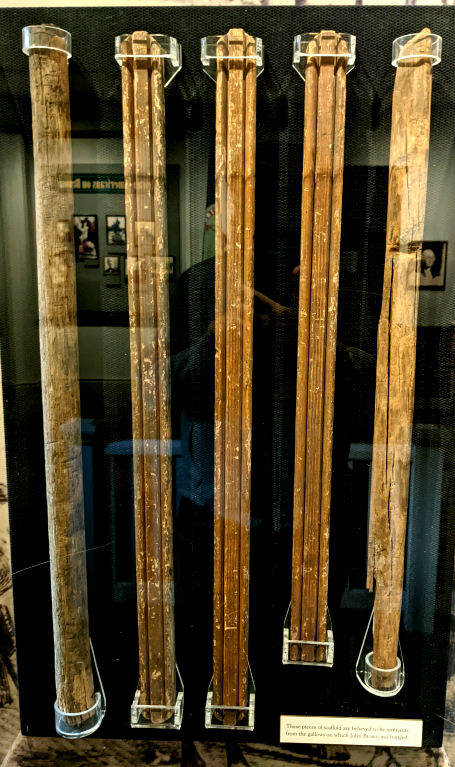
In a quiet building, amid dioramas and other artifacts, I found something that moved me even more than John Brown’s Fort. It was a few scraps of wood sitting behind a glass case. A note next to them read “These pieces of scaffold are believed to be remnants from the gallows on which John Brown was hanged.”

I walked back to The Point and admired the ironwork on the pedestrian bridge over the Potomac. A few years ago a had train slid off the track, sending two cars into the river and smashing its sister bridge, the one reserved for bikes and hikers.. The railroad paid for the repair, and the bridge reopened in 2020.
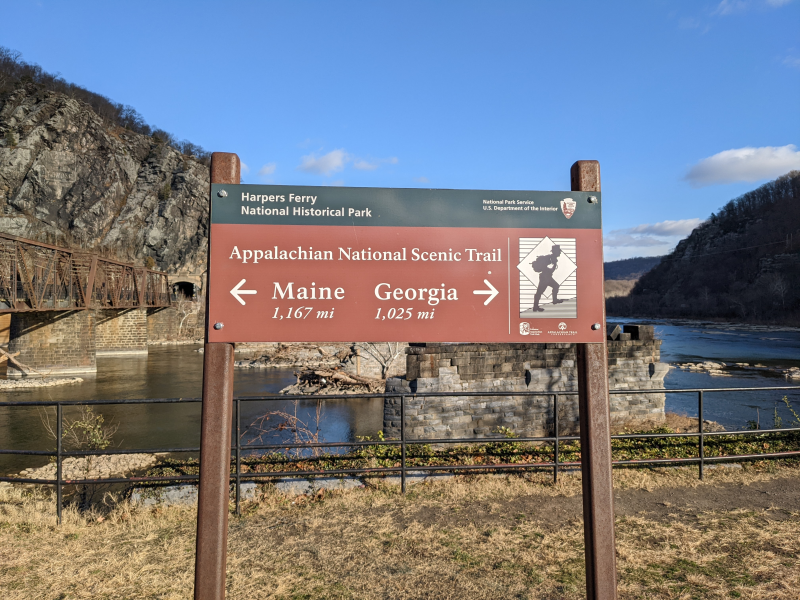
A sign reminded me that this bridge is right around the halfway point of The Appalachian Trail. I’ve dreamed of making that two thousand mile through hike from Georgia’s Springer Mountain to Maine’s Katahdin. It occurred to me that I when people asked about my travels in November and December I could answer “I hiked the Appalachian Trail” without actually lying.
From the bridge the Appalachian Trail heads North towards Pennsylvania. Another trail runs alongside it for a while, one that has been the subject of several hiking and bicycling fantasies of mine: the C&O towpath. This follows the Potomac River for 180 miles between Cumberland, MD and the Watergate complex in DC 5. This is a more realistic fantasy than a through hike of the AT, and I’m hoping to someday make the ride.
Though I wasn’t following the Appalachian Trail I, too was crossing the Potomac and heading North. I followed a route filled with the ghosts of Underground Railroad fugitives and Confederate troops and crossed the state line into Pennsylvania. Signs for Gettysburg zipped by. I’ll visit the battlefield some other day. As I drove I wondered to myself whether I was turning into one of those grey-haired retirees who loves nothing more than visiting a battlefield, and loves boring everyone he meets with bits of Civil war minutia almost as much.
It was dark when I arrived at a bland national chain hotel in Harrisburg, and when I stepped out of the car I was shocked to breathe icy air for the first time since November. This brought home the fact that my travels were coming to an end. No more exploring those colorful exotic lands where snow never falls; you’re headed back to Winter, pal.
I decided to take a look at downtown Harrisburg. My friend Jeff had suggested I park my car on City Island, an urban park in the middle of the Susquehanna River. It was clear from the acres of parking that this was a lively place in warmer weather. It’s the home of a huge minor league baseball park, amusement park style rides, miniature golf and other attractions. But on a Sunday night in late December it was deserted.
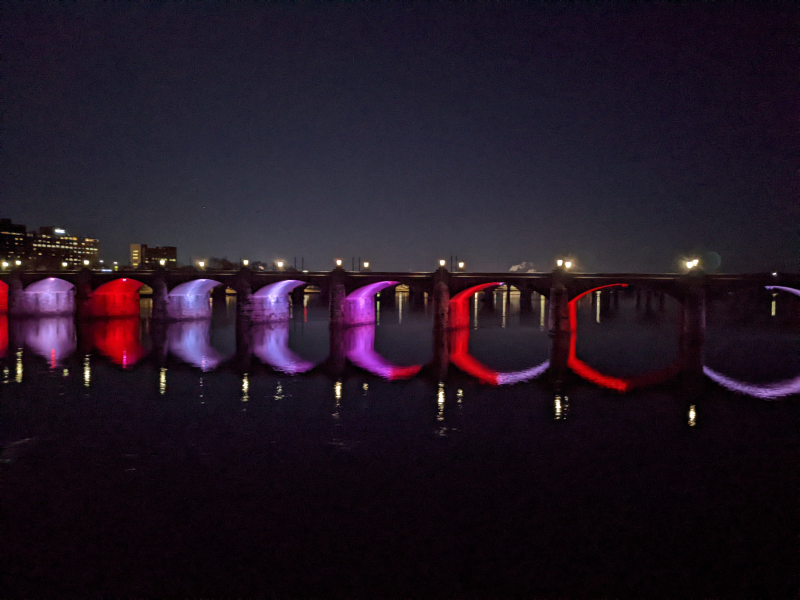
I walked across the Walnut Street Bridge, a lovely steel truss structure built in 1890. The bridge once carried commuters into downtown. It was probably not a smooth ride, judging by its nickname: Old Shaky. One January day in 1996, the river flooded, and one huge chunk of ice after another slammed into the bridge. Two of its seven spans were knocked out and hurled downstream, slamming into the stone arches of the Market Street bridge, 500 feet downstream.
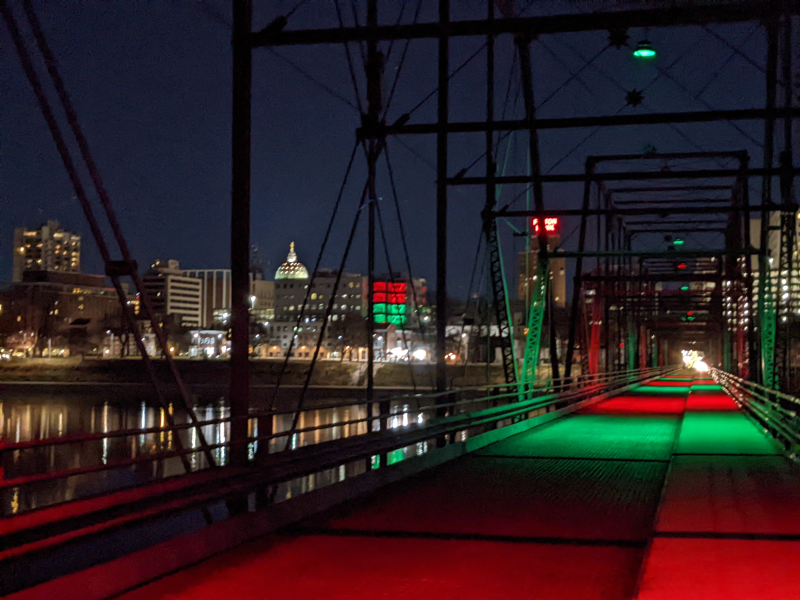
The people of Harrisburg still loved Old Shaky, and have wisely preserved it as a pedestrian and bike bridge. I had the whole span to myself: deserted but colorfully lit in red and green for the season. The dome of the Pennsylvania Capitol was bright on the other side, a bit of whimsy poking out between dull concrete and glass rectangles of the Harrisburg skyline. It’s an unusual dome: light shining from its circular windows making it look like an oversize colander.
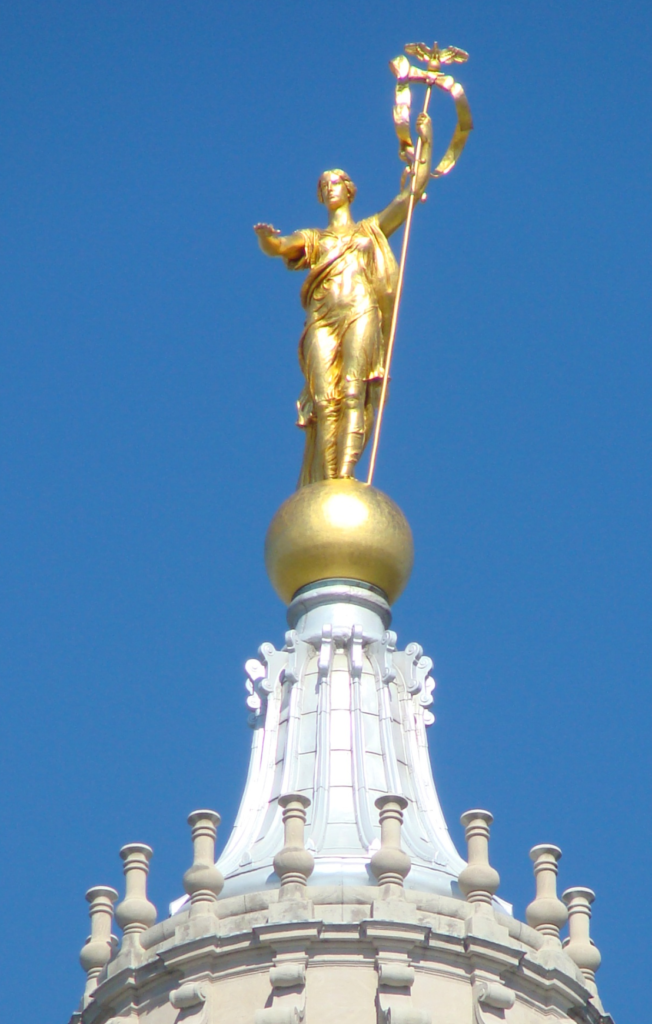
I wandered through the empty streets, past shuttered stores, up State Street to the Capitol grounds. It was dark and quiet except when light and noise emerged from the doorway of a dive bar. Harrisburg looked a little down-at-the-heels to me, though I guess most cities would look that way emptied of people on a cold, dark night. The Capitol building itself was charming (like Wisconsin’s, it’s made from Vermont Granite). The main dome is topped by a gilded female figure called “Commonwealth,” but known to locals as “Miss Penn.” A smaller dome stood on each of the two ornate Beaux-Arts wings of the building. They made me think of two flying saucers that decided to begin their invasion of earth by landing on these impressive roofs.
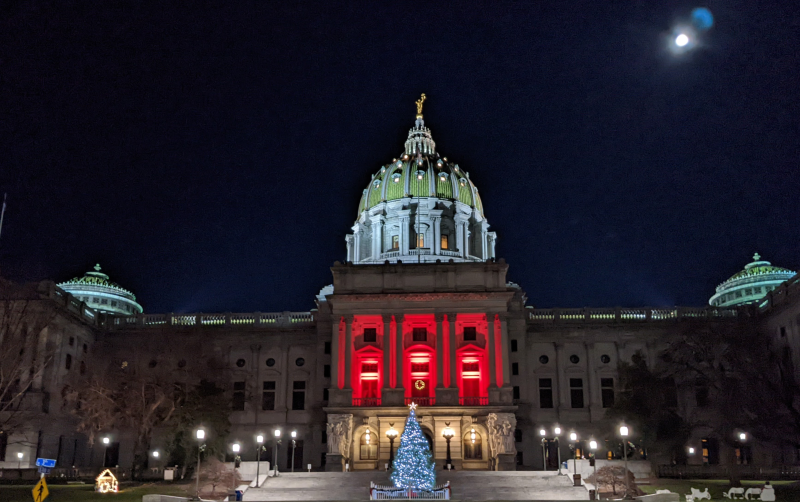
Once again, I found myself wishing for more time. I wanted to see the building in the daylight: In the red and green glare of Christmas lighting I could barely make out huge columns, massive doors, and big, complicated marble sculptures. A historic marker quoted President Teddy Roosevelt: “This is the handsomest building I ever saw.”at its 1906 dedication.
But the road was calling. I had less than eight hours of driving time between me and my home, and a few more things I wanted to see before I slept in my own bed.

- Word nerds will note that despite what your spell-checker may think there is no apostrophe in “Harpers Ferry”. In fact there are almost none in any place name in the USA. This is no accident; there’s an official U.S. Board on Geographic Names and it doesn’t like apostrophes.
- If, like me, you weren’t paying attention in history class, that ban was the famous Missouri Compromise of 1820.
- The town was founded by Republican abolitionists, and named after Amos Lawrence, a Massachusetts cotton merchant who became a diehard abolitionist after the “Burns Affair” of 1854. Anthony Burns escaped from slavery in Virginia only to be captured and put on trial in Boston. Bostonians protested, rioted, and attempted to rescue him, but he was transported back to his “owners” in Virginia under the protection of Federal troops.
- In a weird foreshadowing of the coming Civil War, the marines were led by future Confederate generals Robert E. Lee and Jeb Stuart.
- The Watergate complex, which gave its name to the hotel, the Nixon-era scandal that occurred there, and ultimately the -gate suffix used for dozens of scandals, got its own name from a Potomac River canal gate that controlled the flow into D.C.’s Tidal Basin reservoir.
One thing I learned as a Vermont Statehouse tour guide is that there is a dedicated group of travelers that aspire to visit every statehouse in America.