
Ward offered me a chance to join him on an early morning bicycle ride around his neighborhood. He loaned me a bike that was sleek and lightweight though it had comically-large, knobby tires. I’d seen people using these to ride on snow in Vermont winters. The bike was a joy to ride, especially off the path in some of the surrounding parks. I suspected that my aerobically-challenged pace was pretty poky for Ward, but he’s polite and tolerant, so I’ll never know for sure. The tires made cheerful humming noises as we rode on some of the neighborhood streets, and I wondered if I could learn to control my speed precisely enough to play a tune.
My plan that morning was to explore Montgomery by myself. Ward had a video call with his daughter (he’s teaching and mentoring her as she navigates Medical school), and Lisa had other obligations. Much as I wanted to spend time with them, I was glad for the chance to wander by myself. I like to learn about a new place by walking around and seeing what I might stumble across, and Montgomery was a city I wanted to get to know.
Sadly, two of the things I most wanted to see, the National Memorial for Peace and Justice (often called “The Lynching Memorial”) and the Legacy Museum (a museum about the history of slavery, legal segregation, and modern incarceration policies) were closed on the one day I was in town, but I was able to walk around Montgomery and at least visit the Rosa Parks museum.
Rosa Parks is one of my heroes. She’s famous for standing up to Jim Crow laws by refusing to move to the back of the bus to allow a white passenger to sit in front. This was in 1955, and her action triggered the Montgomery Bus Boycott, a year-long effort that desegregated transportation in the South, brought Martin Luther King to national attention, and sparked the Civil Rights movement I remember from my childhood.
She appears to be an honored citizen in her home town, too. There are statues of her scattered around the downtown, and the museum is a major attraction. But appearances can be deceptive. In the aftermath of the bus boycott she and her husband were blacklisted by every white employer. Unable to find work, broke and facing constant death threats, the couple were forced to leave town.

I was grateful that the museum was careful to put her action in context. It’s so easy to see history as a story of brave, triumphant heroes working alone. There is no doubt that Rosa Parks was brave, is a hero, and did triumph. But this museum isn’t afraid to show her as one member of a group of local activists determined to stand up to the city’s racist laws and change the course of history. They highlight the lives of many of those other activists, and discuss her training in nonviolent direct action at the Highlander Center.
In fact, Parks wasn’t even the first woman in this city to refuse to give up her bus seat. Earlier that year Claudette Colvin, a friend of Parks and a fellow activist, had done the same thing. She was arrested and charged with disturbing the peace, violating the segregation laws and (allegedly) assaulting a police officer. But Colvin was an unmarried, pregnant teenager. The Civil Rights leadership in town didn’t think she would be good for the image of the movement.
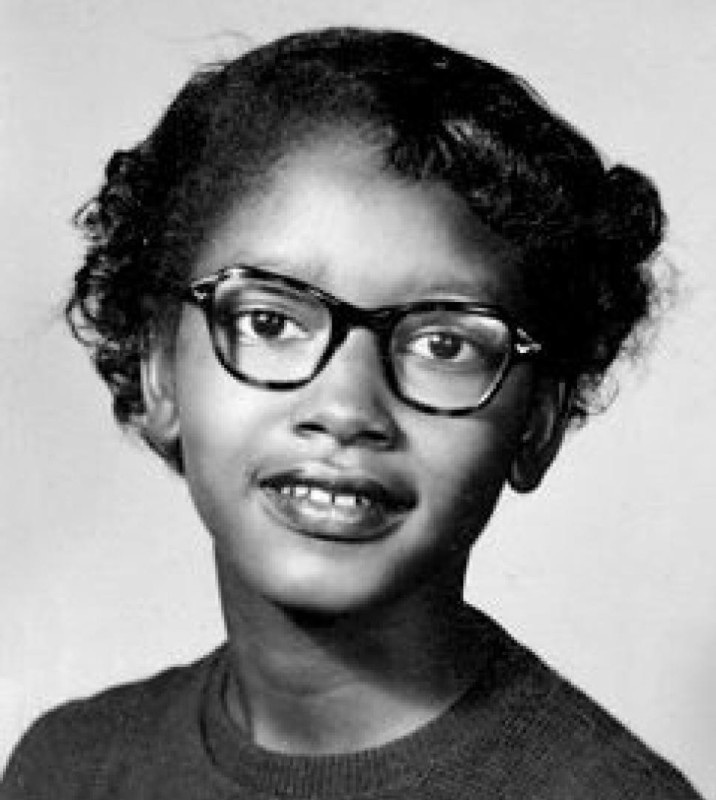
(public domain image via Wikimedia)
I learned that just a few weeks before I arrived in Montgomery her convictions had finally been finally been expunged 1 with the judge calling her action “a courageous act,” Of course this was more than half a century late; Colvin is 86 years old now and, like Parks, had long ago been forced out of town for her leadership of the bus boycott.
I also appreciated that the museum wanted to put Rosa Park’s struggle into the broader context of global fights for human rights. Entering the museum, I wandered into a traveling exhibit called “Ten Japanese-American Concentration Camps” In 1942, Franklin Delano Roosevelt signed an executive order that sent more than 100,000 Americans to isolated camps scattered across the West for the crime of their Japanese heritage. The exhibit placed U.S. Government propaganda photos and text alongside recent photos of the isolated, empty places where the ramshackle camps were built. Small containers of soil from those places were mounted under the pictures.

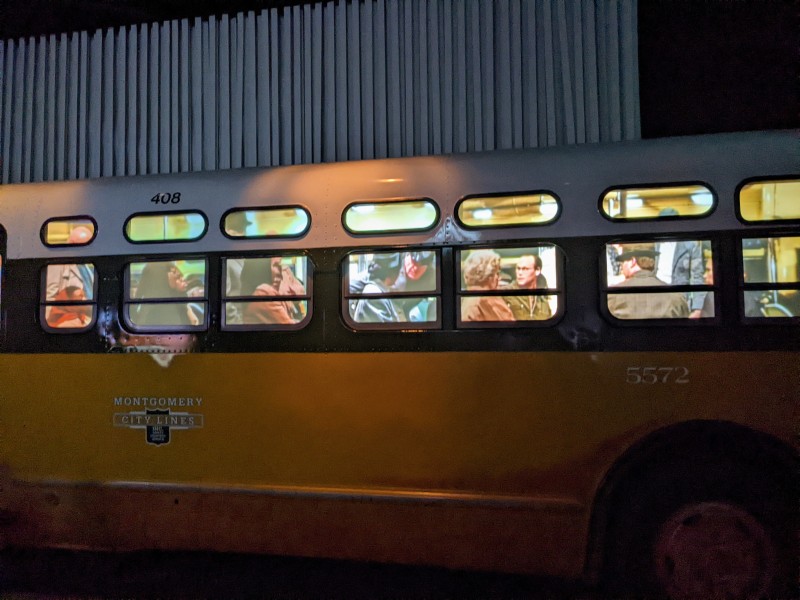
The centerpiece of the museum is a sound-and-video recreation of Rosa Parks’ signature act of resistance. Video screens are built into the body of an actual bus identical to the one she rode. Visitors can watch the drama unfold as the armed white bus driver challenges Parks and calls in Montgomery police who arrest her and lead her off.
Other galleries show the history of the bus boycott that followed her action. Mimeographed fliers calling for the boycott are displayed next to the original mimeograph machine that printed them. It brought back memories of my many hours turning the crank of that old piece of printing technology.

What fascinated me most were the clippings from Montgomery’s newspapers. When the boycott began the headlines were mostly quotes from the city’s leaders explaining that it was that it sure to fail. As the boycott began to bite into the city’s economy, the mood changed. One story headed “Physical Fear Of Negroes Blamed For Bus Boycott” quoted Police Commissioner Clyde Sellers. He explained that the “good” Blacks were being scared off of buses by militant “Goon Squads.” It struck my how similar this was to the kind of disinformation I see today from right-wing media.
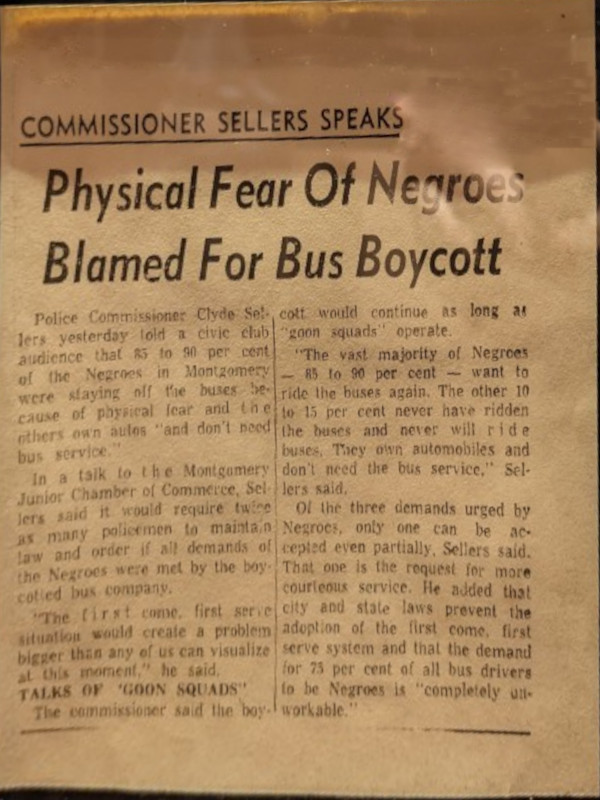
One thing I learned that astounded me: the protesters weren’t asking for the buses to be integrated. I suppose this common-sense request was unthinkably radical at the time. The official demand was merely that riders would be seated “…on a first-come, first-served basis – Negroes seating from the back of the bus toward the front while whites seated from the front toward the back.”
When the home of a young organizer named Martin Luther King was bombed the local papers ignored the real act of terror against Dr. King, running the headline “Threat of Retaliatory Bombing Given to Commissioner Sellers.” The story went on at length about white people’s fear of violent backlash from the Black community. “In the wake of a dynamite blast last night at the home of an outspoken Negro bus boycott leader, Police Commissioner Clyde Sellers revealed today he had been threatened with the same thing.”

I walked out of the museum, squinted at the bright December sunshine and strolled up the hill to the Capitol building. It was on the steps of this imposing Greek-revival building in 1965 that Martin Luther King spoke to people who had arrived after a long march from Selma to Montgomery. The marchers had twice tried to reach the capital, only to be turned back, threatened and violently attacked by both local vigilantes and Alabama state troopers. On this third march King gave this speech:
They told us we wouldn’t get here. And there were those who said that we would get here only over their dead bodies, but all the world today knows that we are here and we are standing before the forces of power …
We are on the move now.
Yes, we are on the move and no wave of racism can stop us.
We are on the move now. The burning of our churches will not deter us. The bombing of our homes will not dissuade us.
We are on the move now. The beating and killing of our clergymen and young people will not divert us.
We are on the move now…Like an idea whose time has come, not even the marching of mighty armies can halt us.”
The city is starting to show pride in its Civil Rights legacy, but the ghosts of the confederacy still haunt this Capitol hill. It was in the Senate Chamber here where The Confederate States of America were founded, and across Washington Street from the capitol stands a tidy little mansion with a sign that reads “The First White House of the Confederacy.” I entered and chatted up the docent. He was friendly, kind, decent and knowledgeable, happy and proud to talk to this wandering Yankee about the architecture, furnishings, and other less controversial aspects of the place. But when I diplomatically asked if changing times had made for any recent changes in the exhibits, he didn’t answer, instead telling me “Well, these days even George Washington is no longer a hero.”

The “Confederate White House” is owned, staffed, and supported by the taxpayers of the state of Alabama. A legislative act in 1923 established it as “an institution for the cultivation of Confederate history, the preservation of Confederate relics and a reminder for all time of how pure and great were Southern Statesmen and Southern valor.” To be honest, as much as I wasn’t happy that it existed, I have to admit that it didn’t feel like a shrine to the rebellion. The gift shop didn’t sell confederate battle flags, toy Confederate soldiers, or anything blatantly offensive. Some exhibits showed a meek and sheepish adulation of Jefferson Davis and his family, but I saw nothing openly encouraging the myth of the South’s noble “lost cause.” The exhibits didn’t push out obvious falsehoods; it was more like the museum was looking at a wide panorama of history through a very narrow pair of blinders.
But the relative tolerance of the place was apparently only skin deep. A few weeks after my visit, a Black woman named Evelyn England left her job as a receptionist and tour guide at the “Confederate White House” after twelve years. It was not a friendly goodbye. She was suspended from her job in January 2022, and she was openly critical of the skewed view of history presented at the site. In February she filed a racial discrimination complaint with the EEOC.
Ms. England was a child at the height of the Civil Rights movement. In 1965 her cousin, Jimmy Lee Jackson, was beaten, shot and killed by a state trooper while participating in a peaceful protest. The officer was convicted of manslaughter, but not until 2010. And his sentence was six months in jail.
Before I left the Confederate White House I made a point of using the restroom. It was a feeble gesture, but it was a small socially acceptable act that I could make in lieu of actually urinating on Jeff Davis’s grave.
Later that day I returned downtown with Lisa to visit the Freedom Rides museum, housed in the old Greyhound terminal. By 1961, segregation in bus terminals had been declared unconstitutional by the U.S. Supreme Court. A group of activists, black and white, women and men, vowed to ignore Jim Crow laws and travel together from Washington, DC to New Orleans to test the law.
They never made it to New Orleans. The first group of these “Freedom Riders,” had their bus firebombed in Anniston, Alabama. They regrouped, and on May 20th they arrived in Montgomery. There they were greeted by a mob armed with baseball bats, tire irons, and bricks. Organizer John Lewis and other riders were severely injured, but the others insisted on continuing on as far as Jackson, Mississippi. There they were arrested for “breach of the peace” and sent to the notorious Parchman state penitentiary, a maximum security prison farm modeled on antebellum slave plantations. There they were subjected to constant humiliation by the guards, were placed in a chain gang, given inedible food, and had their mattresses and bug screens taken away. They sang together to keep their spirits up. As the summer wore on other activists joined them. Eventually over 300 women and men were incarcerated at Parchman for Civil Rights actions.


The exhibits in the museum were informative and moving, but what hit me the hardest was part of the architecture of the building. To the left of the terminal entrance is a walled-up archway, the remains of the “colored entrance.” It led to a separate waiting room with a separate ticket window, separate bathroom, and separate lunch counter. Separate and unequal of course. A sign over the bricked-up doorway reminded us that entering via the wrong door was a criminal offense.
My visit with Ward and Lisa was a short one. I was fed delicious food (Ward is a good cook, and for one dinner they indulged my request for local barbecue, though I got the impression it wasn’t something they often ordered) and I truly enjoyed their company. We had one brief evening of reminiscing, but the time had come for me to move on again.
Well done on the symbolic bio break at the Confederate White House.