
I’m headed up the Blue Ridge Parkway to Charlottesville, Virginia. Like Charlotte, North Carolina it was named after the wife of King George, the dude we rebelled against in 1776, a woman known mainly for bringing the first Christmas tree to England. We have a town in Vermont named after her, too, but for some reason we pronounce it “CharLOTTE,” with the accent on the second syllable.

I’m eager to see the Blue Ridge Parkway. Like the Natchez Trace, the Blue Ridge was another of those WPA era mash-ups of recreational driving, history, and nature, and if it was half as awe-inspiring as the Trace, I didn’t want to miss it.
To be honest, I’m noticing a three-way battle being fought in my soul. FOMO (fear of missing out), that mental disease endemic to tourism, makes me want to linger at each new place. Wanderlust, that characteristic American drive to be a rolling stone, makes me want to hop in my car and roll down the road to any next place. And the still-feeble but growing magnetic pull of my Vermont home and my sweetheart is telling me to wrap it all up.

The Blue Ridge Parkway connects Tennessee’s Smoky Mountains National Park to Shenandoah National Park in Virginia. I’d visited the Smokies long ago, hiking with one foot in Georgia and one in Tennessee, but I’ve never seen Shenandoah (though I’ve sung that song about the river a lot). I wanted time in both places, but that wasn’t going to happen. I wouldn’t even get to see much of the Parkway. My visit to Charlotte left most of the 500-mile road to my South. I’d only have time to see sixty or so of the northernmost miles. But first I wanted to take another detour, to a place called Natural Bridge.
Natural Bridge State Park in the Shenandoah Valley of Northwest Virginia is the site of a stone arch carved by Cedar creek. The creek feeds into the James River, which cuts East across the Blue Ridge Mountains, headed for Chesapeake Bay and the Atlantic. There’s some uncertainty about how the arch was formed. I started to look this up, but reading about geology seems to numb my mind. I struggled through pages filled with synclines, stratigraphic units and Ordovician-age dolomitic formations. My takeaway is that it’s probably all that’s left of the collapsed roof of an underground river. But maybe not, say some geologists. I’d like to suggest that it may have been made by ancient, giant worm-like alien invaders trying unsuccessfully to escape the darts shot by fierce inhabitants wielding atlatls.
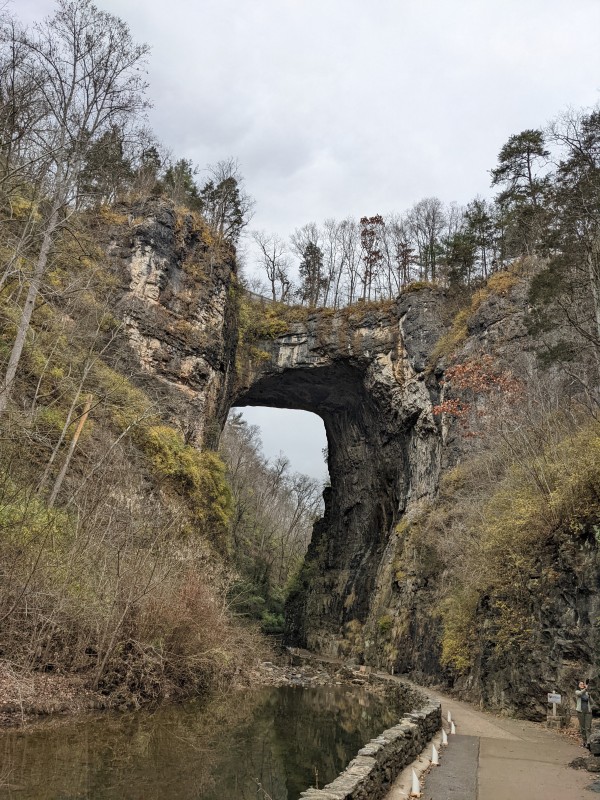
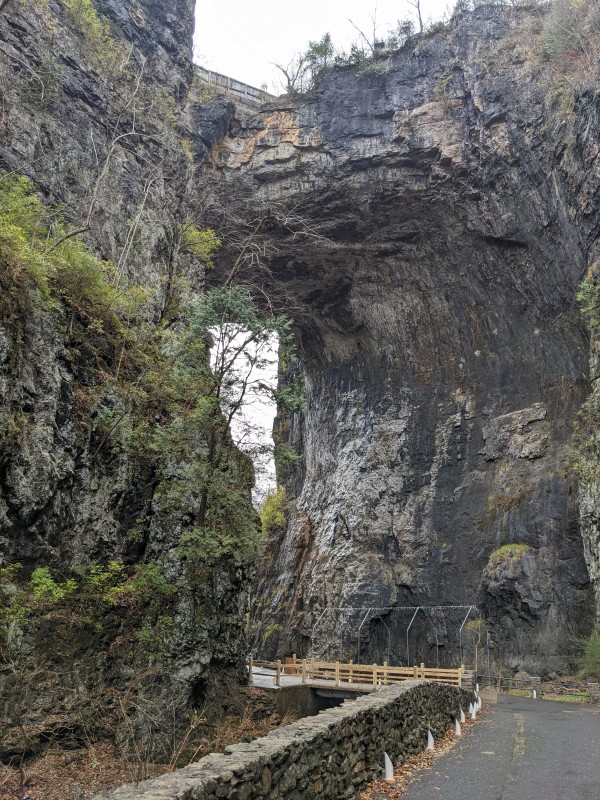
It’s awesome enough to see that it’s been a tourist attraction since the white colonizers first arrived on the heels of smallpox and influenza pandemics that nearly wiped out the original Monacan inhabitants. A plaque (placed by the Daughters of the American Revolution in the 1920’s 1) claims that George Washington surveyed the site, though many historians say “probably not.” The plaque doesn’t mention another well-known but even less plausible story: that Washington hurled a stone from the creek bottom over the 215-foot high bridge. The DAR did get one story right: the land had been owned by Thomas Jefferson. He made frequent visits, built a vacation cabin, and was said to have entertained John Marshall, James Monroe, Martin Van Buren and other famous Virginians here. Though “he built a cabin” probably can’t be accurate: I’m sure his enslaved workers did most of the construction.
The park visitor’s center has an ample parking lot (near empty at present), a huge gift shop, and exhibits of Virginia products. Just inside the doors was a small desk with maps, brochures and a bored state employee running a cash register. I bought my required admission ticket and walked behind the building to the trail entrance. The trail is steep but well-maintained. It runs alongside Cedar creek where the tiny but lively stream has carved a deep, narrow canyon. The path runs down this dark, woodsy notch, showing off a series of rapids and miniature waterfalls. At the bottom the trail widens and levels out, and after crossing another parking lot I caught my first glimpse of the arch.
It’s beautiful and romantic looking, reminding me of the red rock arches I’ve seen in Utah. The trail (now a level, paved walkway) continues along the creek and passes directly underneath the arch. It’s a cold, wet Saturday morning with very few visitors, and I’m surprised at how peaceful the creek bottom is. Route 11 (the highway I drove to get here) runs atop the arch, but it’s far enough away that there’s no sound or sight of the cars and trucks racing overhead.
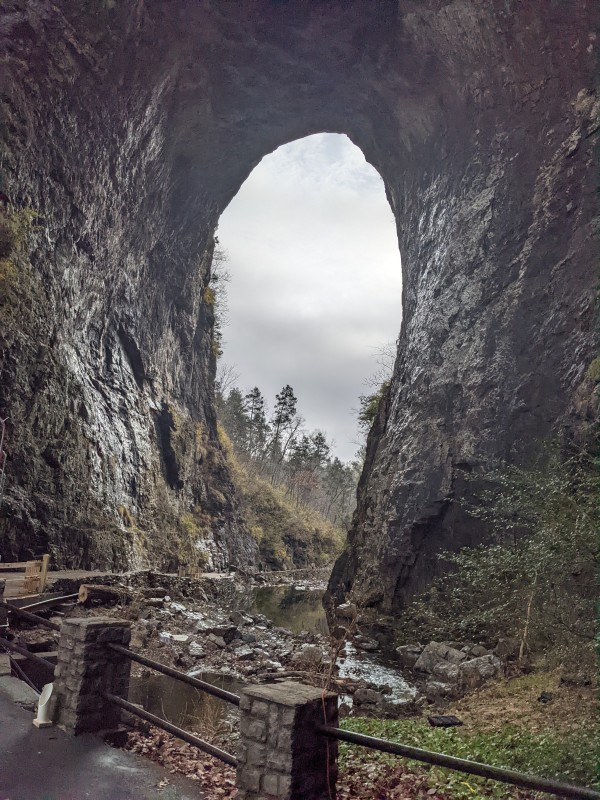
I noticed a sign mounted on trail-side post. It announced something called “The Drama of Creation Program” and explained, puzzlingly, that “no state funds or personnel are used for the provision of this program.” I later learned that this is a music and light show featuring readings of the Biblical creation story. It’s a favorite of religious fundamentalists on TripAdvisor and other social media.
The spectacle was kicked off by President Coolidge in 1927 to show off the new technology of electric light. The Bible readings were added several years later. A book written in 1940 called the bridge “a monument to the patience of Old Mother Nature and her skill as an artist” and described the event:
…by night, with modern electrification, one is spellbound by its beauty—and when sweet music fills the glen with its symphonies one’s soul is lifted to the Greatest Artist of all—to God in reverence and gratitude.

The trail ends at a sign that reads Monacan Village. This appears to be a “living history” reproduction of a native community, but today it looked empty and abandoned. I wasn’t sure if this was because of COVID, budget cuts, or something else. The site was fenced in, and the empty longhouse and other structures appeared to be in sad, soggy, disrepair.
I was frankly pleased that the exhibit wasn’t open. I had convinced myself that this would be another example of native traditions and people being displayed as curiosities and attractions for white tourists. I’m happy to say that was wrong. The Monacan Village is an authentic and painstaking reproduction of how the arch’s original inhabitants lived, a labor of love by a couple named Dean and Victoria Ferguson. The couple are members of the federally-recognized Monacan Nation. The Monocans were the original inhabitants of Natural bridge, which they called Mohomony: “The Bridge of God.” For over 20 years the Fergusons have diligently built and maintained these structures based on the best archaeological information available. I wish I could have been here when it was open.

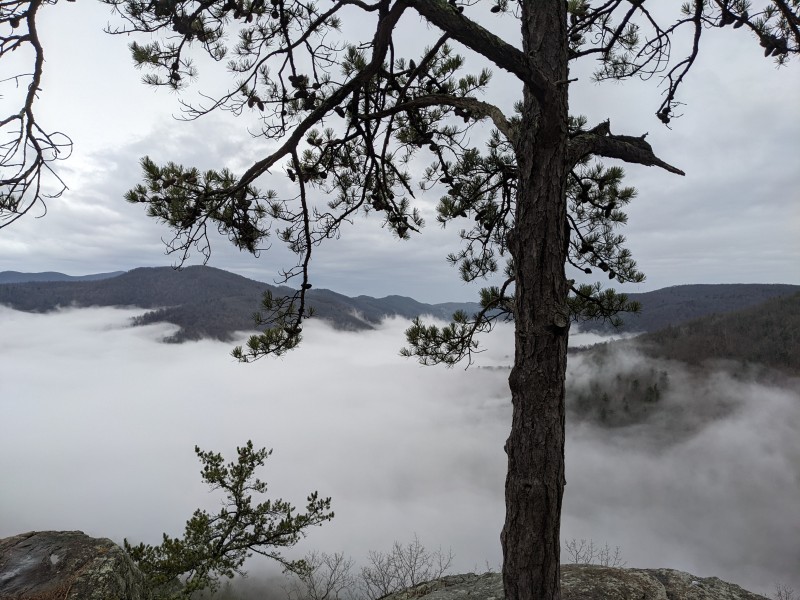
I finally entered the Blue Ridge Parkway at the James River, just west of Lynchburg, eager to drive the aforementioned sixty miles to the North entrance near Charlottesville. The river is the low point of the parkway, a mere 650 feet above sea level. Fifteen miles South of here it crosses the Peaks of Otter at an elevation of nearly 4,000 feet. The morning remained cool and grey as I followed the parkway North, back up into the clouds. My visibility was limited, but driving at parkway speeds on the winding road wasn’t uncomfortable. I saw very few other cars, and I could see through the fog well enough to avoid any wildlife that might cross my path. I stopped at a few pullovers, a little frustrated to be missing mountain vistas but enjoying the wispy fingers of cloud flitting around dripping pine trees. And the wet, piny smell was a joy. A few dozen more miles brought me above the clouds, and I looked out at what could almost be a mountain lake, the low hills and high peaks like a placid shoreline around the grey cloud banks.


Ahead was Charlottesville, where I would visit my old friends Harris and Ellie Tobias. We met in the 1970s when they were a young couple with an infant child named Avrom and I was a college student. Nostalgia is a vice of the old, and I found mind wandering back to those days as I drove.
It was a remarkable time. I headed out into the world as part of an entire generation that questioned the life their parents had handed them. Maybe it was because we were the first generation to be linked by television, maybe it was because of a consumer economy that was happy to sell to us as a single demographic, or maybe the stars had turned and the Age of Aquarius was about to begin. Whatever the reason, we were high on the fumes of rebellion and creation that filled the air.
The counterculture of the 1960s and 1970s was an echo of the howl raised by the beatniks. We felt Like Charlie Chaplin in the 1936 movie “Modern Times” our generation being offered a life as a cog in a machine we neither controlled or understood. We rejected the offer, uninterested in becoming a grey-suited man working in an office or a woman trapped with her children in a ticky-tacky suburban box.

And we knew that the machine we resisted was malicious. Our friends were being sent to Vietnam, halfway around the world to kill and to die in a war that made no sense to us. Our rivers and lakes had become sewers and toxic waste dumps. The air we were breathing was poisoned. We lived minutes away from a global nuclear catastrophe. We saw people stepped on and abused because of the color of their skin. Our heroes: JFK, Robert Kennedy and Martin Luther King, were gunned down one after another.
While we knew something was very wrong, we didn’t know what was needed to set things right. The ideas we landed on in our youthful folly were legendary. Some thought our parents were worshiping the wrong Gods, and they chased after the most exotic and unfamiliar beliefs they could find, shaving their heads, chanting and meditating. Radical politics became a kind of religion for others. The Merry Pranksters and Timothy Leary convinced many of us that the problem was in our brain chemistry, and that LSD and marijuana would fix things. Maybe the problem was our parents’ shoes: Yoga instructor Anna Kalsø’s “The Earth Shoe,” with a heel in the front, promised to align our bodies and change our consciousness.

Maybe the best strategy was not think too hard about what was wrong, but to create a new world based on our hopes and dreams. Our generation was showed so much brilliance creating our own music and art; we might as well make our own civilization. Stewart Brand’s Whole Earth Catalog announced “We are as gods and might as well get good at it” and offered access to garden tools, art supplies, construction equipment and even early, primitive personal computers.

Driving along the cloud tops, I remembered Joni Mitchell’s song “Woodstock” a song that kinda became our anthem:
…I’m going down to Yasgur’s farm, gonna join in a rock and roll band.
Got to get back to the land, and set my soul free.
We are stardust, we are golden, we are billion year old carbon,
And we got to get ourselves back to the garden.
I was fresh out of high school and excited to be away from home at a college looked magical to me. Based on John Dewey’s ideas about progressive education, Goddard has never had required classes, grades or exams. It called itself “a community of scholars.” Students developed their own study plans. They were also expected to work together to keep the college running – washing dishes and mopping floors in the cafeteria, maintaining the grounds, serving on the college fire department, and even constructing new campus buildings. It seemed to me a place where music, art, and independent thought would flourish, and I was eager to be a part of it.

Harris had been part of a National Guard unit that got called to Vietnam. He refused to go, claiming to be a conscientious objector. After a brief stint in the brig, he wound up in New York City working as a writer for a large corporation. Harris, his wife Ellie, and baby Avrom were looking for a place that was peaceful and rural but hip and culturally exciting. When they got to the small village of Plainfield, Vermont, the home of Goddard College, they knew they had arrived.
The hippies flooded into Vermont in the 1970s, and Goddard became a magnet for young creative people. Some of these newcomers were young men hiding out from the draft, making up new names for themselves, and please to be close to the Canadian border.
The hills around Plainfield began to fill up with poets, musicians, dancers and artists. Followers of exotic and unusual religious, spiritual, and dietary regimes swarmed in. Legions of crazy, creative and remarkable people settled into the village. Vermont was a poor state, a northern outpost of Appalachia, so to support themselves they took up organic farming, massage therapy, baking, candle making, freeloading, and acupuncture. Communes, alternative schools, a local newspaper and a food co-op sprouted up.
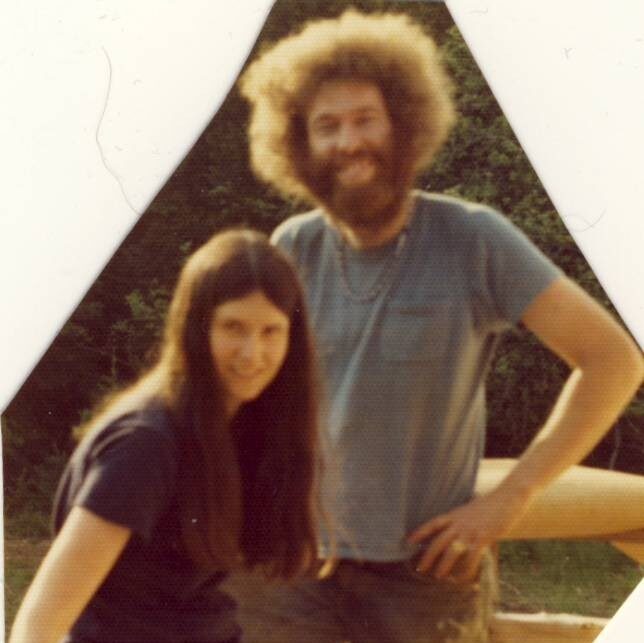
There was a tiny store called “Earth Artisans” on the roadside just outside the village. It was owned by a potter who sold his ceramics along with local bread, garden produce, granola, eggs and a few other foodstuffs. Ellie and Harris bought the shop, moving into the apartment behind the shop. They would turn it into a “Natural Food Store,” a new idea at the time. It was a perfect fit for Plainfield, and Earth Artisans became a sort of crossroads of the town’s exploding counterculture.

I soon became the store’s first employee and a close friend to the couple. I worked a few days a week at the store. We added a small counter and started serving bread, soup, and other simple food, and when Harris managed to score a beautiful antique soda fountain (from Ben Cohen of Ben and Jerry’s fame) we sold Ice Cream too. I also spent countless evenings in the tiny set of rooms behind the store that was their home. We would play Scrabble, pass a joint or a bottle of wine, laugh and joke, and dream up ridiculous new business ideas. The store bought bulk quantities of products like honey, maple syrup and peanut butter and we would pack these into pint and quart jars for sale. When we got bored with writing “Peanut Butter” or “Honey” on the sticky labels we would make up funny brand names for the products. Eventually Harris hired a local artist to create labels. He created “Three Sheiks Tahini,” “Belle of Plainfield Safflower Oil,” and “Big Nuts Peanut Butter” (“Ask your grocer if he has Big Nuts!”).

In time another son, Jonah, was born. Harris built the family a home on a wooded hill a few miles from Plainfield and opened a second store in Montpelier where I worked for a time. By the 1980s I had left Vermont for Boston and they had moved closer to family in Long Island. There they opened a store that sold educational toys, and a daughter, Miriam, was born. A few years later they picked up home and store and moved to Charlottesville. They bought a lovely old house on top of a quiet wooded hill. Miriam married a young man named Jason, and Harris teamed up with his son in law, using the skills he had learned in Vermont to build another new house for the couple on that hill.
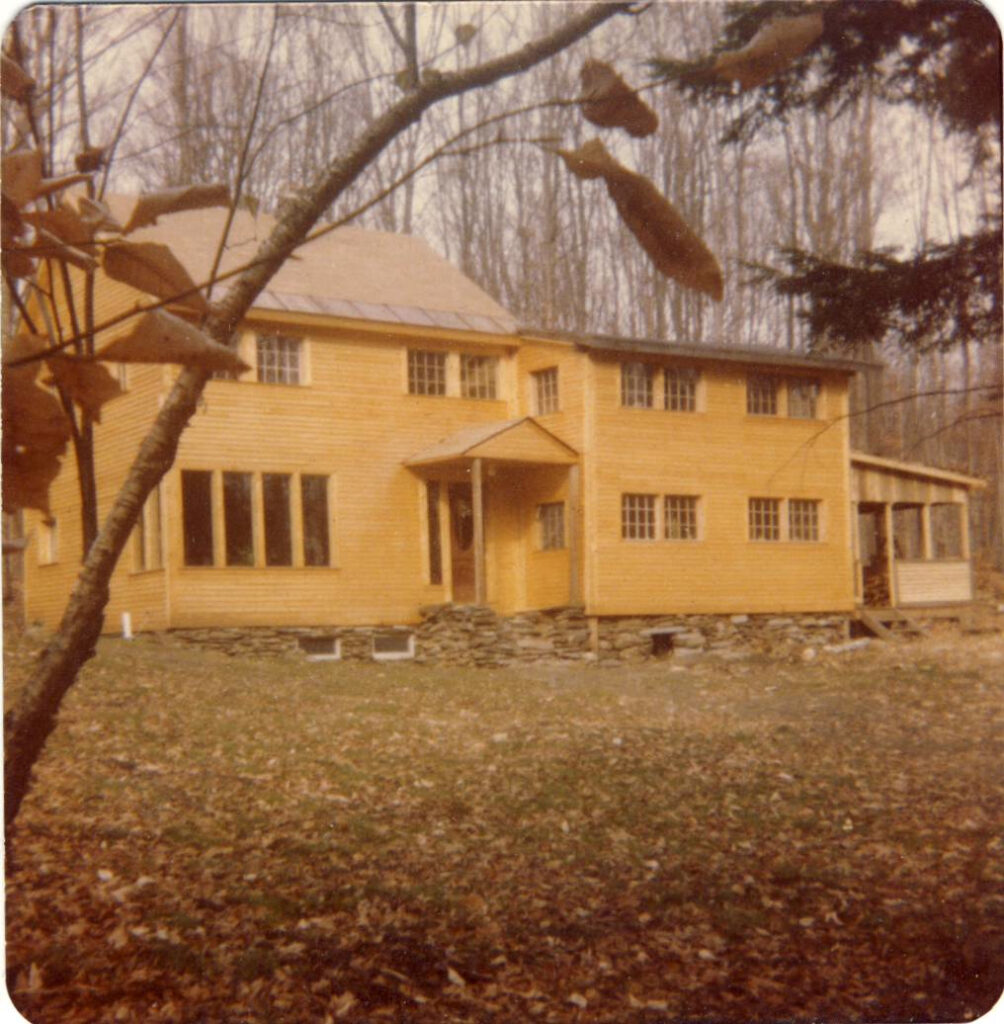
By the time the century rolled over their three children and a gaggle of grandchildren had joined them in Charlottesville. Avrom was running the educational toy business (now a wholesale operation). Building that new house on their little hilltop was a life-changing experience for Jason, who started his own business designing and building homes.
The Blue Ridge parkway came to an end, and I snapped out of my nostalgic reverie and turned toward Charlottesville. Suburban developments had been encroaching on Harris and Ellie’s little hill for quite a while now. If you enter their address into Google Maps, Street View shows you a row of brand-new closely-packed townhouses, but there’s a patch of trees hiding in the middle of this subdivision, and a tiny driveway peeks out of it. I turned onto that driveway, suddenly in a Virginia forest, and headed up the steep, shady road to their home.
Once again I’m greeted warmly, fed well, and given a lovely room to sleep in. By coincidence Harris’s brother, who was also part of the 70s hippy madness in Vermont and is now a doctor nearby, shows up. Once again I’m in a flurry of reminiscing and catching up. I’m staying the night so I’m not feeling too rushed or worrying too much about the clock running out on our time together. We walk out the back door a few steps, where Jason proudly shows me the house that he and Harris built. When daughter Miriam shows up to say goodnight, fresh from the opening of a gallery exhibit of her work, I learn about the burgeoning art scene in Charlotte. We talk about some of the nation’s best cideries, the winemakers, Jefferson’s Monticello and University of Virginia and the other sights I’ll be skipping. Once again my need to move on, wander off to the next place, and head back towards home is fighting with my desire to spend more time with my friends and enjoy the places I visit.
I’ll be leaving early tomorrow. I’m eager to visit Harper’s Ferry, West Virginia.
- I learned from Historian James Lowen’s wonderful book Lies Across America that the trick to understanding historical markers is to pay as much attention to the date they were installed as you pay the date they commemorate.
How lovely to find old friends and reminisce.